Biomethane: from biogas resource to qualified renewable gas supply.
Biomethane is methane-rich gas produced by cleaning and upgrading suitable biogas or landfill gas to the specification required for its intended use. It can serve compatible gas customers through a connection, dedicated supply or appropriate transported-gas route. The case for upgrading depends on measured gas quantity and composition, treatment requirements, methane recovery, output quality, delivery, customers and the value of the gas's current use. Biomethane is not the same as untreated biogas, and upgrading does not by itself create additional feedstock.
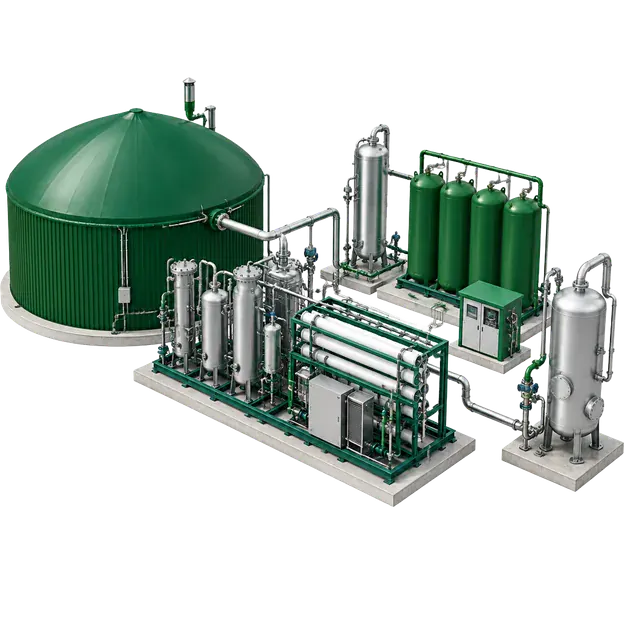
How biomethane production works
Organic resource → biogas production or collection → contaminant removal → upgrading → metering and product testing → delivery → customer.
Anaerobic digestion commonly produces a mixture including methane and carbon dioxide, with trace contaminants that vary by resource and process. Landfill gas also requires careful assessment of its composition and contaminants. Upgrading removes much of the CO₂ and impurities to increase methane concentration. Technologies can include membrane separation, water scrubbing, chemical scrubbing or pressure-swing adsorption. Technology choice depends on real gas composition, scale, energy demand, site constraints, recovery and supplier performance evidence.
Existing facilities can be an important starting point
A plant already producing and using biogas may have an operating digester, material handling, experienced people and measured gas data. That does not mean upgrading is automatically the best investment. The commercial comparison must include lost or reduced CHP electricity, heat or on-site gas use, additional electricity, new maintenance requirements, connection work, certificates and contracted gas revenue.
For greenfield projects, seasonal feedstock supply, storage and pretreatment, digestate outlets and access to customers should be established before equipment sizing. A national biomass-potential estimate is not a feedstock contract.
Which delivery route fits the buyer?
| Configuration | Best question to resolve |
|---|---|
| Direct on-site consumption | Would continued biogas use, cleaning or new equipment provide a lower-cost service? |
| Dedicated nearby supply | Can a local industrial customer contract a defined gas quality, volume and reliability? |
| Gas-network injection | Does the operator have physical capacity, gas-quality acceptance and a viable connection offer? |
| Compressed or liquefied delivery | Are conditioning, storage, loading, transport, unloading and customer equipment economic? |
| Shared upgrading/regional hub | Does aggregation overcome additional feedstock haulage, coordination and infrastructure expense? |
Reverse-flow compression can sometimes expand the usable network catchment when local demand is low; it is an engineering and cost-allocation question, not a feature required by every biomethane plant.
Gas quality, renewable origin and reporting are different controls
A safe, compatible gas product must meet the applicable gas-quality and operating requirements. Separately, renewable-gas certification may establish eligible biogenic origin or the environmental attributes a buyer is permitted to claim. Emissions intensity requires relevant lifecycle and methane-loss accounting; certificates do not replace physical gas testing or automatically prove delivery of particular molecules to a customer.
The CO₂ and digestate opportunity
Biomethane upgrading separates a CO₂-rich stream at suitable plants. BioCO₂ recovery may be commercially worthwhile where purity, compression/liquefaction, storage, customer grade and netback are demonstrated. Separated CO₂ is not automatically recovered, saleable or permanently removed. Anaerobic-digestion facilities also produce digestate, which may require further treatment, testing, storage and lawful agricultural outlets. Revenue is recognised only when supported by qualified quantities and demand.
Biomethane versus other pathways
A technology-neutral feasibility model should compare biomethane with the alternatives available to the same site and customer: on-site gas use, CHP, industrial heat, upgrading with BioCO₂ recovery, biomethane-to-BioH₂ conversion and non-bioenergy options where relevant. The preferred configuration is the one with a defensible whole-system commercial and emissions case - not simply the highest volume of methane injected into a grid.
Build the commercial evidence
Before progressing a potential Australian project, document:
- at least representative gas-flow, methane, CO₂, sulphur and relevant contaminant samples;
- feedstock reliability, competing uses and operating performance;
- CAPEX/OPEX scope and utilisation assumptions, including compression and methane slip;
- connection or road-delivery route, quality requirements and preliminary customer terms;
- energy sales, certificate ownership, qualified co-product netbacks and any eligible support;
- approvals for inputs, plant, gas delivery and any product by-products; and
- lifecycle emissions and maintenance/service capability throughout the operating life.
References and provenance
Shelby October 2026 policy submission Q02/Q19–Q25/Q27–Q29/Q37/Q40–Q43. Australian operating precedent: Malabar project. Project-specific performance and law must be verified before investment decisions.
Biomethane delivered-cost gap
Natural gas commodity references are a comparison boundary, not a biomethane producer price. Keep biomethane production costs, network injection or direct-delivery charges, customer willingness to pay and producer offtake assumptions separate. The shared approved release has no biomethane price observations.
Renewable premiums and certificate eligibility
Record contracted premiums and certificate eligibility separately from the underlying gas price. Verify enacted scheme rules, ownership, retirement and support stacking for the project. Hypothetical policy support remains a sensitivity assumption, never a contracted revenue or guaranteed premium.
Frequently asked questions
Is biomethane the same as biogas?
No. Biogas commonly contains methane, carbon dioxide and contaminants. Biomethane has been cleaned and upgraded for its particular use and specification.
Does upgrading always increase gas production?
No. It changes gas composition and saleable use. With the same upstream biogas flow it need not increase total methane generated, and some methane may be lost in processing.
Can every operating biogas site sell biomethane into a network?
No. Gas quantities, quality, connection conditions, seasonal network demand, infrastructure investment, approvals and a viable customer contract must all support the project.
Sources & References
- Shelby Bioenergy, Shelby’s National Renewable Gas Policy consultation response
Publication: 2026-10
Observation period: October 2026
Relevant page / section: Supplied company position
Last link / title verification: Not verified
Company position / supplied material, not independent evidence.
Proposals and scenarios, not adopted policy or market offers.
- GreenPower, Renewable Gas Certification Rules – version 3.0
Publication: 2025-07-03
Observation period: Publisher page retrieved 11 October 2026
Relevant page / section: Key changes and effective date
Last link / title verification: 2026-10-11
Publisher link checked; individual claims, costs and regulatory applicability still require review.
Scheme eligibility and registry terms must be checked for the actual product.