Renewable gas versus natural gas: understand the complete cost gap.
The renewable-gas cost gap is the difference between the revenue a project needs to finance sustainable production and delivery, and the income realistically available from customers and eligible support. It varies with feedstock, technology, size, utilisation, infrastructure, customer contracts and financing. It cannot be measured by comparing a supplier's equipment quote to a wholesale natural-gas price. For biomethane, a credible comparison separates production cost, delivered cost, fossil-gas benchmark, renewable attributes, proposed or enacted support and qualifying co-product netbacks.
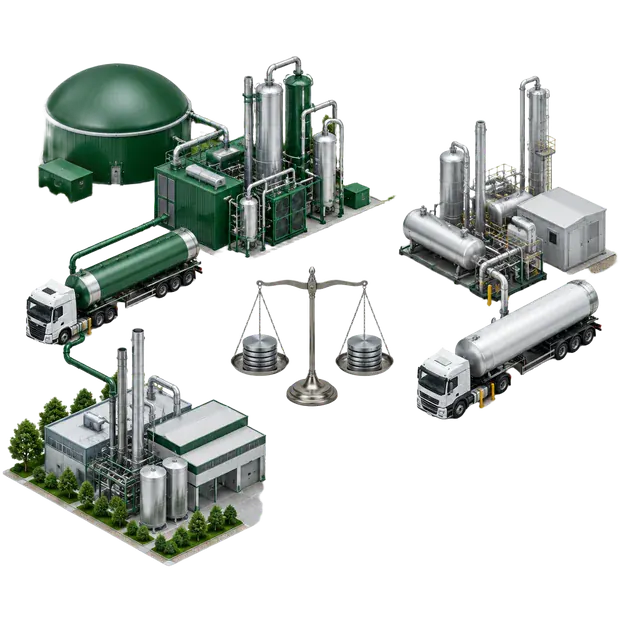
First define what is being compared
A renewable gas can compete with natural gas for a customer's specific service: industrial steam, direct heat, chemical feedstock or another gas requirement. The comparison must state delivery location, gas quality, energy or calorific basis, currency year, load profile, contract term and any emissions obligations.
| Component | Correct treatment |
|---|---|
| Plant-gate renewable-gas production cost | Feedstock, conversion, gas treatment, operating cost, finance and appropriate capital recovery |
| Delivered renewable-gas cost | Add connection, compression, transport, storage, metering, certification and customer-interface costs not already included |
| Fossil natural-gas comparator | Use a customer-relevant delivered benchmark for the same energy basis and contract conditions |
| Customer willingness to pay | Use buyer evidence or offers; do not assume a universal green premium |
| Production support and grants | Identify the enacted eligibility, payer, duration and capital/revenue treatment; model policy proposals separately |
| Co-product revenue | Include only a net producer return after qualification, handling, storage and delivery; avoid double counting attributes |
Biomethane: different feedstocks, different costs
Landfill gas, wastewater biogas, manure digestion, commercial organic waste and crop residues are not interchangeable cost cases. Input quality, collection costs and contamination treatment can outweigh benefits from equipment scale. An existing facility may reuse feedstock contracts, digesters, electrical infrastructure or operations staff, but upgrading can displace on-site heat or electricity and must be evaluated against that lost value.
A credible model therefore compares: continue current use, upgrade to biomethane, add a qualified co-product recovery step, supply locally or via a network, and, where warranted, develop a shared or larger facility. The least-cost option is not necessarily the one producing the most upgraded gas.
What Shelby proposed in its 2026 consultation
Shelby's National Renewable Gas Policy submission recommended testing a total biomethane revenue range of approximately A$140–200/MWh HHV (approximately A$39–56/GJ HHV), with A$160–180/MWh HHV as a central early-project policy-design range. This is not a quoted market gas price, an enacted tariff, a guaranteed revenue rate or solely the public subsidy. It is a policy-modelling assumption that combines potential commodity, support and certificate value, subject to project evidence.
The submission also proposed testing approximately 15 years for early purchasing or equivalent revenue-support arrangements, subject to financing needs, and targeted eligible capital assistance. Neither recommendation represents a universal minimum requirement or a confirmed Australian national scheme.
For project-sensitivity studies only, Shelby highlighted 0.10, 0.15 and 0.20 PJ/year as reference sizes - not minimum efficient scales. Government support and supplier price quotes should never be back-calculated from these examples as if available to a specific project.
What can close the cost gap?
- Efficient resource use: predictable feedstock and minimal hauling, pretreatment and contamination losses.
- Right-sized technology: credible capacity, utilisation and scope rather than nominal nameplate performance.
- Existing-plant upgrades: reuse of sound assets while accounting for any displaced energy service.
- Appropriate infrastructure: transparent connection processes, compression and shared network investment when benefits are demonstrated.
- Revenue certainty: qualified offtake, duration, price review and eligible policy mechanisms that lenders can evaluate.
- Co-product commercialisation: digestate, recovered biogenic CO₂ or other products with verified quantities and customers.
- Clear approvals and certification: earlier resolution of costs and project delays without weakening environmental or gas-quality requirements.
These measures may close a financing gap in suitable circumstances; none guarantees commercial viability. A project should remain a no-go if dependable feedstock, delivery, emissions performance or buyer demand cannot be established.
How to model the gap without double counting
Treat the output as a cash-flow model, not a promotional percentage:
- Select a product and boundary (e.g. saleable biomethane GJ/year HHV delivered to a named customer).
- Estimate production and delivery CAPEX/OPEX on the same annual output and inflation basis.
- Model the real customer commodity price and any contracted premium separately.
- Record certificates once, with confirmed eligibility and ownership.
- Treat grants as reductions to eligible project costs or associated cash flow, not as a second perpetual production payment.
- Add qualified co-products only at defensible netback, with actual recovery, quality and market limits.
- Compare financing, utilisation, electricity and feedstock sensitivities; show the unsupported case alongside any policy-support scenario.
References and provenance
Shelby October 2026 submitted consultation responses Q21–Q25 (cost gap), Q40–Q43 (co-products), Q04–Q05 (policy support); consultation hub. Inputs remain indicative and require independent engineering and financial validation.
Frequently asked questions
Is renewable biomethane always more expensive than fossil natural gas?
There is no single national project cost or customer comparator. Specific feedstocks, equipment reuse, customer alternatives, transport, utilisation and support arrangements change the result.
Is Shelby's A$140–200/MWh HHV range a government tariff?
No. It is Shelby's October 2026 consultation policy-modelling test range for total biomethane revenue. It must not be described as approved government support or a market price.
Can BioCO₂ and digestate sales make a project bankable?
They can improve economics where measured saleable quantities, lawful product status, specifications and credible buyers support net revenues. Speculative revenue should remain an upside sensitivity, not a bankable base case.
Sources & References
- Shelby Bioenergy, Shelby’s National Renewable Gas Policy consultation response
Publication: 2026-10
Observation period: October 2026
Relevant page / section: Supplied company position
Last link / title verification: Not verified
Company position / supplied material, not independent evidence.
Proposals and scenarios, not adopted policy or market offers.