Hydrogen pathways: start with the customer, compare the full system.
Hydrogen can be produced using different feedstocks and technologies. An Australian project should compare renewable-electricity electrolysis, eligible biomethane-to-hydrogen conversion and other technically relevant routes on delivered hydrogen cost, lifecycle emissions, energy and water demand, reliability and the buyer's exact specification. Hydrogen purity alone does not establish fuel-cell compliance or renewable origin. An assessment must establish the production boundary, certification conditions and customer requirements before recommending a route.
Hydrogen: latest public references
Retail refuelling and modelled production costs are separate references. Neither establishes a current bulk industrial buyer price.
Delivered industrial quote: project-specific, not established by these references. Figures exclude GST only where tax is evidenced. Unknown or study-specific tax remains source-native.
| Reference | Price | Period and boundary | Source |
|---|---|---|---|
| Geelong dispenser quote | A$30.00 to A$30.00/kg; Excluding GST | June 2025 operator FAQ; October 2026 price not reconfirmed; Corio / Geelong, Victoria; Roll-up dispenser sales, not delivered bulk industrial supply or producer offtake | Viva Energy; PDF page 1, How much does Hydrogen cost per kg?; checked 2026-10-14 |
| ARENA renewable hydrogen cost context | A$6.00 to A$9.00/kg; Study basis; GST not established | 21 March 2025 commentary; not a current buyer quotation; Australia; Cost to produce renewable hydrogen, not a delivered sale price; no site-specific volume or supply contract | ARENA; Opening cost discussion: cost to make one kilogram with current technology; checked 2026-10-15 |
| Renewable electrolysis | A$5.00 to A$10.00/kg; Study basis; GST not established | 2024 strategy baseline, not a 2026 price quote; Australia; source-specific; Production cost, not a delivered buyer price; compression, transport, margins and tax require separate confirmation | DCCEEW; Objective 1: A globally cost-competitive hydrogen industry; paragraph preceding Figure 5, Levelised Cost of Hydrogen production by method over time; checked 2026-10-13 |
Display conversion uses an indicative 30-day average, not a real-time rate. Calculations, project prices and downloads remain AUD.
Why hydrogen is not a single technology
Hydrogen is an energy carrier and industrial input, not a naturally interchangeable substitute for every gas. Production routes have different requirements for electricity, process heat, gas, water, compression, distribution and carbon management. An attractive factory-gate production figure may be less competitive once delivery, storage, utilisation and customer equipment are included. For Shelby Bioenergy, hydrogen is a possible project output, not a predetermined solution.
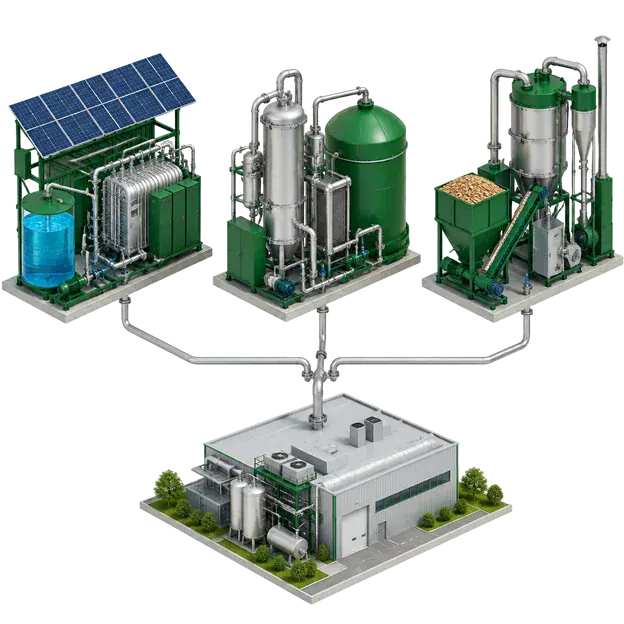
Three routes to compare
| Route | Main inputs and conversion | Principal project questions |
|---|---|---|
| Renewable-electricity electrolysis | Electricity and suitably treated water; electrolyser makes hydrogen and oxygen | Hourly electricity availability, tariffs, load factor, water, compression, demand matching and renewable-claim eligibility |
| Biomethane or biogas to BioH₂ | Sustainable methane-rich biogenic gas; cleaning, reforming/conversion, hydrogen separation | Opportunity cost of biomethane, gas contaminants, process energy, methane leakage, biogenic CO₂ recovery or storage, end-user and certification |
| Biomass thermochemical hydrogen | Eligible biomass processed through gasification and downstream gas conditioning | Feedstock specification, tar/ash handling, demonstrated scale, conversion yields, emissions, gas cleanup and technology readiness |
Fossil natural-gas reforming may be relevant as a cost or emissions comparator, but it is not a bioenergy-based renewable hydrogen route merely because capture technology is installed. Electric and biogenic routes must be assessed against equivalent product and delivery boundaries.
Compare the same hydrogen service
First, define whether the customer needs process hydrogen, refining feedstock, metal processing or a fuel-cell grade product. Then establish kilograms per day, peak demand, minimum pressure, purity and permitted trace contaminants, delivery location, storage, redundancy and contract duration. Automotive proton-exchange-membrane fuel cells can require stringent impurity limits beyond a headline 99.99% purity figure; a producer must meet the applicable detailed specification, testing and validation.
Shelby's assessment should document the delivered cost per kilogram and the emissions intensity of the entire relevant chain, rather than compare electricity consumption alone. For example, electrolysis generally requires substantial electrical input; biomethane reforming also consumes the chemical energy of methane. Low auxiliary electricity demand for a reformer does not imply low total energy use.
What determines a credible BioH₂ case?
A credible biogenic hydrogen project needs independently supported answers to the following questions:
- Is the biogenic gas available in sufficient measured quantity and quality, and what useful alternative use would it displace?
- What conversion, purification, compression and storage equipment is required at the proposed scale?
- What are realistic availability, process yields, electricity and heat requirements and maintenance arrangements?
- Where does the biogenic CO₂ go? Is there a lawful, technically feasible recovery, utilisation or storage case - and which emissions are actually counted?
- Which buyer is able to accept the delivered product at a price and term that support investment?
- What Australian fuel, safety, product and environmental certification requirements apply to this precise process and claim?
Deliver near the user or distribute from a hub?
Hydrogen can be made near feedstock supply, at an existing biogas facility, at a shared processing hub or near the industrial customer from delivered biomethane. Each layout creates different costs for gas transport, hydrogen storage and trucking, electricity connections, safety setbacks and specialist servicing. A distributed network is commercially preferable only when its delivered cost and reliability outperform the alternatives.
What Shelby evaluates
Assess → Compare → Optimise → Advance. Shelby's Australian-developed decision-support approach starts with resource and customer data, checks technical fit, compares scenarios and identifies missing evidence. Qualified projects may then proceed to specialist engineering, permitting, supplier due diligence, financing and development activities through suitable partners. Screening is not engineering certification, bankable feasibility or a guarantee of grant eligibility.
References and provenance
Shelby's October 2026 National Renewable Gas Policy submission, Q02/Q19–Q20; Shelby consultation hub; BioH₂ existing page; Clean Energy Regulator, Product Guarantee of Origin products lists electrolysis as the first eligible hydrogen method and other routes as upcoming (publisher page checked 11 October 2026). Verify the applicable product methodology and detailed fuel standard for the actual process; no automatic BioH₂ certification or fuel-cell conformity is claimed.
What is the current all-in price?
Current consumer price for pure hydrogen, excluding GST (AUD/kg)
No verified figure. No verified current Australian bulk industrial buyer price. Viva Energy's June 2025 Geelong FAQ publishes a roll-up dispenser quote of A$30/kg excluding GST (A$33/kg including GST). This is retail refuelling, not a bulk industrial supply contract, and its October 2026 price was not reconfirmed. Published production costs are a separate evidence class. Not included: The DCCEEW A$5 to A$10/kg range on the hydrogen page is a modelled production cost, not a consumer price.
Viva Energy: FAQs: Viva Energy Hub Hydrogen Refuelling Station, PDF page 1, How much does Hydrogen cost per kg?
Hydrogen prices, cost estimates and outlook
Screening context only. Not current offers, bulk BioCO₂ transaction prices or calculator defaults. Calculations and exports remain AUD; interactive display conversion uses an indicative ECB average.
| Reference | Range | Evidence and boundary | Sources & References |
|---|---|---|---|
| Geelong dispenser quote | A$30.00 to A$30.00/kg | published-retail-quote. AUD 30/kg excluding GST; operator also states AUD 33/kg including GST. Roll-up dispenser sales, not delivered bulk industrial supply or producer offtake. June 2025 operator FAQ; October 2026 price not reconfirmed. Dated outlet quote, not a national price index or a current industrial quotation. No automatic calculator use; reconfirm price, availability, purity and pressure with the operator. | Viva Energy: FAQs: Viva Energy Hub Hydrogen Refuelling Station. PDF page 1, How much does Hydrogen cost per kg?. Published June 2025; checked 2026-10-14. Concise attributed factual price reference only. Operator document marked restricted; no document, artwork or compiled data reproduced or hosted. |
| ARENA renewable hydrogen cost context | A$6.00 to A$9.00/kg | modelled-production-cost. AUD 6 to 9/kg production-cost commentary; dollar year and GST not specified. Cost to produce renewable hydrogen, not a delivered sale price; no site-specific volume or supply contract. 21 March 2025 commentary; not a current buyer quotation. Dated indicative production-cost commentary, not transactions or a BioH₂ reforming benchmark. No calculator prefill. | ARENA: The role of oxygen in advancing the renewable hydrogen industry. Opening cost discussion: cost to make one kilogram with current technology. Published 2025-03-21; checked 2026-10-15. Concise attributed factual reference only; no article images or text reproduced; no government endorsement. |
| Renewable electrolysis | A$5.00 to A$10.00/kg | modelled-production-cost. Australian dollars as reported; underlying dollar year not specified in this passage. Production cost, not a delivered buyer price; compression, transport, margins and tax require separate confirmation. 2024 strategy baseline, not a 2026 price quote. Published strategy estimate, not an observed sale, current offer or BioH₂ reforming benchmark. No figures digitised from graph artwork. | DCCEEW: National Hydrogen Strategy 2024. Objective 1: A globally cost-competitive hydrogen industry; paragraph preceding Figure 5, Levelised Cost of Hydrogen production by method over time. Published 2024-09-13; checked 2026-10-13. Based on Commonwealth of Australia (DCCEEW) 2024 material, CC BY 4.0. Shelby presentation; no government endorsement. |
Evidence still needed
CSIRO pathway comparison: exact chart values pending. The December 2025 technical appendix states 2024 AUD (section 2.1) and lists production and fuel assumptions (Tables 8–9), not the supplied approximate levelised-cost results. Approximate graph values remain withheld until reconciled to exact model outputs. Production cost is not a customer price. Source & verification context
No national annual bulk-buyer observations established for 2016–2025. Supplied 2027–2036 indexed curves are arbitrary sensitivities, not assessed market forecasts.
Projected cost reductions, not an observed price trend
The 2024 National Hydrogen Strategy anticipates renewable-energy costs falling by 40 to 60% and electrolyser costs by 88 to 94% by 2050. These are model assumptions, not realised savings or hydrogen buyer-price forecasts. Its Figure 5 compares production pathways, but exact future values have not been inferred from the artwork. Biomethane reforming needs its own feedstock, conversion, emissions and delivery assumptions; this electrolysis range must not substitute for a BioH₂ quotation.
- Electricity supply and electrolyser utilisation
- Capital cost, financing and plant scale
- Compression, storage and distance to the buyer
DCCEEW: National Hydrogen Strategy 2024. Objective 1: production-cost outlook and Figure 5; published 13 September 2024. Checked 13 October 2026.
DCCEEW: Growing Australia's hydrogen industry, updated 30 January 2026Frequently asked questions
Is all renewable hydrogen biohydrogen?
No. BioH₂ identifies a hydrogen pathway involving eligible biological inputs. Hydrogen from qualifying renewable-electricity electrolysis uses a different production and accounting pathway.
Does 99.99% hydrogen purity mean fuel-cell ready?
Not by itself. The relevant fuel specification sets limits on individual impurities, sampling and quality assurance as well as total hydrogen content.
Is reforming biomethane always cheaper than electrolysis?
No. Results depend on the price and availability of biomethane, plant scale and utilisation, conversion and carbon management, electricity, financing, delivery and customer requirements. Published case-study costs should not be treated as universal Australian project prices.
Sources & References
- Shelby Bioenergy, Shelby’s National Renewable Gas Policy consultation response
Publication: 2026-10
Observation period: October 2026
Relevant page / section: Supplied company position
Last link / title verification: Not verified
Company position / supplied material, not independent evidence.
Proposals and scenarios, not adopted policy or market offers.
- Clean Energy Regulator, Guarantee of Origin Scheme launches
Publication: 2025-11-03
Observation period: Publisher page retrieved 11 October 2026
Relevant page / section: Scheme launch; initial hydrogen coverage and proposed expansion
Last link / title verification: 2026-10-11
Publisher link checked; individual claims, costs and regulatory applicability still require review.
Launch does not establish eligibility of every renewable-gas production route.
- Clean Energy Regulator, Product Guarantee of Origin products
Publication: 2025-11-03
Observation period: Publisher page retrieved 11 October 2026
Relevant page / section: Hydrogen: electrolysis; Upcoming products
Last link / title verification: 2026-10-11
Publisher link checked; individual claims, costs and regulatory applicability still require review.
Retrieved page lists electrolysis first and other routes/products as upcoming. No confirmed biomethane commencement date inferred.