Bioenergy-based renewable gases: the right product starts with the right resource.
Bioenergy-based renewable gases are gaseous fuels or intermediates produced from qualifying biological material. Examples include biogas, upgraded biomethane, bio-derived hydrogen and eligible bioLPG pathways. They differ in composition, technical maturity, infrastructure compatibility and end users. A promising resource becomes a credible project only when the feedstock, conversion system, output specification, delivery route and customer work together. Broader renewable gases, such as electrolytic hydrogen and some synthetic methane, are not necessarily bioenergy-derived.
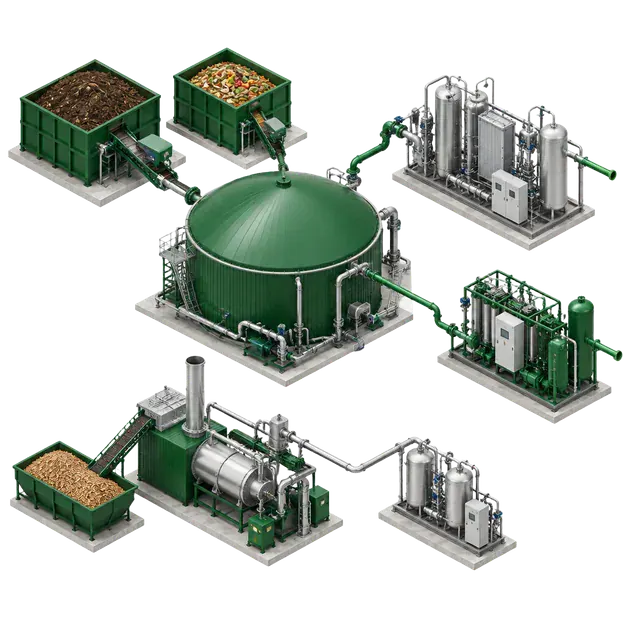
Understand the different products
| Product | Typical pathway | What matters commercially |
|---|---|---|
| Biogas | Anaerobic digestion of organic waste, manure, wastewater residues and suitable crops | Variable methane/CO₂ composition, contaminants, on-site use, CHP or upgrading |
| Biomethane | Biogas or landfill-gas conditioning and upgrading to an applicable methane specification | Methane recovery, gas quality, metering, grid access or direct/off-grid offtake |
| BioH₂ | Suitable biomass or cleaned biomethane converted to hydrogen and purified | Customer specification, fuel/process energy, lifecycle carbon and biogenic CO₂ management |
| BioLPG | Eligible bio-based conversion/refining routes, often linked to suitable oils/fats or bio-refining | Proof of biomass origin, LPG product specification, limited feedstock supply and competing markets |
| Biogenic synthesis gas | Thermochemical conversion of suitable biomass | Gas composition and contaminants; further treatment usually required before end use or fuel synthesis |
Biogas is not biomethane; biomethane is not a ready-made source of hydrogen; and BioCO₂ is a recoverable co-product, not a fuel. These differences matter when comparing production, certification and revenue.
Start with available, sustainable feedstock - not regional potential alone
An indicative national or regional resource figure is a screening signal. A bankable supply case requires measured or reliably characterised input volume, composition, yield, contamination, seasonality, collection radius, costs, competing uses and contractual control. Manure at a contained livestock facility differs from material dispersed across grazing land. Food waste can require segregation, screening and pre-treatment. Digestate or other process outputs need lawful outlets.
Choose how much processing creates actual value
Direct-use biogas can meet a nearby site's heat and power demand without installing a full upgrading train. Biomethane upgrading can improve market access where network or customer specifications justify its extra electricity, purification, metering and delivery costs. Conversion to BioH₂ is a further pathway requiring its own feedstock opportunity-cost and hydrogen buyer case. The project model should test the incremental benefit, not assume every further conversion stage creates a profit.
A technology-neutral decision must also consider CHP, biomass heat and electrification where those better meet the customer's needs.
Infrastructure and certification shape usable supply
Compare on-site combustion, a dedicated customer pipeline, grid injection, compressed gas delivery, liquefied gas or an appropriate hydrogen distribution route. Not every gas is interchangeable in existing equipment. Certification must establish what is being claimed - renewable origin, lifecycle emissions intensity, physical product quality or the ownership of environmental attributes. None of these proves the others automatically.
Evaluate the complete commercial chain
A useful preliminary assessment answers:
- Resource: Can suitable material be secured at the site and for the required period?
- Technology: Is the conversion proven at the proposed size and with the actual contaminants?
- Delivery: Are the gas specification, connection, storage and transport achievable?
- Customer: Who will buy or use the product, and under what quality, price and duration terms?
- Revenue: Which energy, treatment-service, certificate and co-product revenues are separately supportable?
- Permissions: Can the inputs, process and outputs be lawfully managed in the relevant Australian jurisdiction?
Commercialise co-products only where justified
Suitable digesters generate digestate; suitable upgrading systems separate a CO₂-rich stream. Neither is automatically a saleable product. Digestate requires nutrient quality, contaminant controls, suitable agricultural demand and compliant use. BioCO₂ requires purification, testing, storage, logistics and contracted market demand. Biochar comes from relevant thermal processing and should not be shown as an automatic anaerobic-digestion output.
Apply the lessons to Australia
Shelby's preferred early deployment sequence is to examine existing biogas and anaerobic-digestion facilities, then right-sized new regional projects where feedstock, demand and supporting infrastructure justify them. The portfolio may include biomethane, direct-use gas, BioH₂, BioCO₂ recovery or other routes. The technology should follow the evidence rather than a preferred supplier or headline output.
References and provenance
Shelby October 2026 submission Q02/Q19–Q20/Q34–Q43. Related existing content: Anaerobic Digestion, Feedstocks, Co-products.
Frequently asked questions
Is all renewable gas produced from biomass?
No. Renewable electricity can be used to make hydrogen; synthetic gases can incorporate different carbon sources. Only some routes meet the definition of bioenergy-based renewable gas.
Can biomethane be injected into every gas network?
No. Connection capacity, gas quality, metering, applicable standards, compression and commercial arrangements are network-specific.
Do all bioenergy gas projects produce BioCO₂ or biochar?
No. Co-products depend on the feedstock and process. Recoverable CO₂ requires additional processing and buyers; biochar is typically linked to thermochemical conversion, not ordinary anaerobic digestion.
Sources & References
- Shelby Bioenergy, Shelby’s National Renewable Gas Policy consultation response
Publication: 2026-10
Observation period: October 2026
Relevant page / section: Supplied company position
Last link / title verification: Not verified
Company position / supplied material, not independent evidence.
Proposals and scenarios, not adopted policy or market offers.
- GreenPower, Renewable Gas Certification Rules – version 3.0
Publication: 2025-07-03
Observation period: Publisher page retrieved 11 October 2026
Relevant page / section: Key changes and effective date
Last link / title verification: 2026-10-11
Publisher link checked; individual claims, costs and regulatory applicability still require review.
Scheme eligibility and registry terms must be checked for the actual product.