What could you produce, or supply?
Open a working tool for the question you need to test: organise an opportunity brief, estimate feedstock output, compare preliminary project economics or calculate a BioCO₂ contribution. Each calculator uses its supported inputs and declared assumptions.
A calculator output is a starting point for investigation - not a guarantee of production, costs, funding eligibility or profitability. For the proprietary technology, evidence architecture and validation approach behind these tools, read about the Shelby Platform.
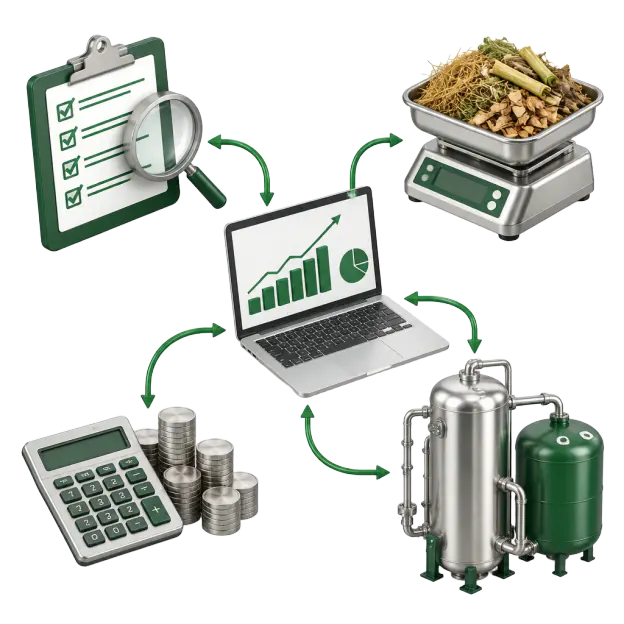
Five connected tools
01. Bioenergy Project Scoping Brief
Find the right questions before choosing the technology.
Start with your role, location, available resource or existing plant, objective and approximate scale. The check helps organise a preliminary project brief, potential pathways and the evidence required for more detailed work.
Best for: All visitors, including early-stage ideas.
02. Feedstock Calculator
Understand the resource behind possible production.
Explore applicable organic-material quantities and characteristics, indicative conversion yields and the operating assumptions that can change useful energy production. Appropriate results depend on declared wet/dry mass bases, solids, composition and technology-specific parameters.
Best for: Farmers, resource aggregators, waste processors and project designers.
03. Project Viability Model
Compare a preliminary cost and revenue case.
Investigate capital and operating assumptions, plant availability, useful product output, transport, customer revenues and sensitivity to key variables. Distinguish measured costs and supplier quotations from published reference values and illustrative scenarios.
Best for: Project developers, plant owners, investors and industrial customers.
04. Co-product Calculator
Test whether a co-product improves the project - after all incremental costs.
Explore possible BioCO₂ or other applicable co-product contributions, including recovery, conditioning, transport, product quality and qualified demand. Potential tonnes are not assumed to be contracted sales or automatically valid carbon removals.
Best for: Existing biogas operators, project developers and potential co-product buyers.
How the tools fit together
Start with a resource or customer requirement → use the Project Scoping Brief.
Test technically relevant inputs and output → use the Feedstock Calculator.
Model indicative project economics → use Project Viability.
Examine incremental products and revenue → use the Co-product Calculator.
Evaluate next steps → project-development and professional review.
Not every project needs every tool. Some inputs and calculations will be outside the current model's supported scope.
Understand the evidence behind results
The four tools retain a shared project boundary privately for the current browser session. Exported assessment records include declared inputs, source/status text, raw outputs, formula versions and screening limitations. Exporting does not submit an enquiry or save to an account.
The feedstock tool supports one methane-yield basis at a time, non-overlapping methane allocations and a limited steam-reforming chemistry check. Project economics distinguishes measured output from annual capacity and provides a constant-annual pre-tax discounted screen. CO₂ remains an annual recovery, qualification and demand screen.
Monthly supply/storage, digestate balances, full tax/debt cash flow, emissions and regional optimisation are not implemented in this release. Software checks do not establish independently validated plant performance.
When to involve engineers and commercial partners
Further development often requires actual plant records, laboratory analysis, site surveys, permits, vendor quotations, energy and gas network enquiries, product specifications, industrial customer agreements and investment due diligence.
A tool can organise these requirements. It cannot replace the organisations authorised and qualified to perform them.
Start with your opportunity. Improve the evidence as you progress.
Frequently asked questions
Which tool should I use first?
The Bioenergy Project Scoping Brief is the best starting point if the project or technology has not yet been defined. Experienced developers can go directly to the relevant specialist calculator.
Does Shelby's output guarantee financial viability?
No. Results depend on inputs, scope, assumptions, uncertainties and future costs and revenues. Professional studies and verified customer evidence are required for consequential decisions.
Can I compare BioH₂ and BioCO₂?
The platform is being developed to compare technically relevant configurations, but those products have different process and market requirements. Only comparisons actually supported by the current released models should be displayed.
Can I use a result in a finance application?
You may use results to organise preliminary thinking, subject to usage terms and data rights. They are not a bankable study or an assurance of performance.
Sources & References
- Australian Renewable Energy Agency (ARENA), Australia’s Bioenergy Roadmap Report
Publication: Date not verified
Observation period: Not recorded
Relevant page / section: Claim-level locator not yet verified
Last link / title verification: 2026-10-11
Publisher link checked; individual claims, costs and regulatory applicability still require review.
Check scope and current applicability before relying on this reference.