Better bioenergy decisions, before the expensive ones.
Bioenergy development involves more than selecting a feedstock or a machine. The right decision requires a coherent view of the resource, the technology, the customers, infrastructure, operating requirements and commercial outcomes.
The Shelby Bioenergy Platform is an Australian-developed decision-support and preliminary-feasibility environment designed to bring those variables into an explainable project assessment - so early opportunities can be compared on consistent terms before detailed engineering begins.
This page explains Shelby’s proprietary decision-support technology, its evidence approach and validation boundaries. To enter inputs and calculate a preliminary result, open the working calculators in Tools & Assessments.
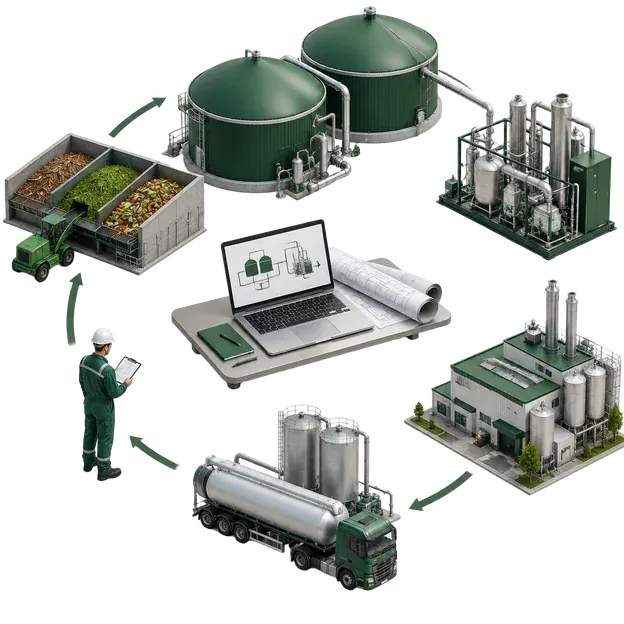
Assess → Compare → Optimise → Advance
1. Assess the opportunity. Enter the known facts about an existing plant, feedstock, proposed site or industrial energy requirement. Establish the baseline, geography, approximate scale and outstanding information.
2. Compare possible configurations. Screen relevant pathways, not a predetermined supplier. Different sites may justify direct-use biogas, CHP, biomethane, BioCO₂, BioH₂, thermal conversion or alternative energy solutions.
3. Optimise the preliminary case. Explore potential production, site constraints, processing and delivery needs, capital and operating costs, customer assumptions and sensitivities. The most productive configuration is not necessarily the most commercially attractive.
4. Advance qualified opportunities. Build an evidence-gap and next-step plan for testing, engineering, connection, approvals, customer contracting, financing and specialist review.
Three Connected Capabilities
Market and project intelligence
Structured Australian and international evidence relating to feedstocks, technologies, energy demand, industrial customers, gas infrastructure, markets, regulation, certification, incentives and deployed projects. Each substantive data point should retain its source, date, geography and measurement basis.
Engineering-informed preliminary modelling
Models use declared technical assumptions, units and calculation boundaries to estimate outputs, constraints and early-stage economics where enough evidence is available. Known site data, supplier specifications, published evidence and modelled scenarios are labelled separately.
Numerical results are intended to come from deterministic, version-controlled calculations. AI may help interpret documents or explain results, but should not fabricate operating performance, costs or equipment specifications.
Commercialisation and project progression
Capture the evidence developed during screening and identify the parties and agreements needed for further development. Potential next stages include measured resource testing, independent feasibility, supplier engagement, customer qualification, environmental and planning studies and appropriate development contracts.
Compare A Complete Project, Not Isolated Equipment
A useful assessment examines six interacting variables:
Resource. Feedstock quantity and quality, seasonal reliability, current uses, procurement rights and collection costs.
Demand. Customer specification, location, purchasing volume, service reliability, contracting period and alternatives.
Technology. Appropriate conversion route, expected efficiency, quality requirements, utilities, losses, availability and constraints.
Infrastructure. Power, water, transport, storage, site access, existing plant interfaces, grid connections and logistics.
Revenue. Product sales, treatment services, eligible certificates and co-products, distinguishing contracted income from unverified assumptions.
Delivery. Approvals, procurement, workforce, spare parts, engineering responsibilities, financing and long-term operations.
The engine should make uncertainty visible rather than assign false precision to missing data.
Built Around The Complete Value Chain
Design → Manufacturing → Distribution → Operations → Maintenance
Shelby's founder experience alongside European engineering and technical teams provides insight into decisions across these five stages. This informs project sizing, buildability, delivery models, operating costs, quality and the need for sustainable local technical support.
Shelby does not claim to be an Australian equipment manufacturer, EPC contractor or operating and maintenance provider. Qualified partners undertake such activities through appropriate project-specific arrangements.
Technology-Neutral. Provider-Transparent.
BioCO₂ and BioH₂ are priority commercialisation pathways, but Shelby's models should not treat them as preferred answers by default. Direct-use biogas, biomethane, CHP, modular deployment, centralised plants and non-bioenergy alternatives need to be considered where relevant.
Supplier relationships and commercial incentives are disclosed where material. Verdemobil's equipment and project references remain Verdemobil's, while Shelby's Australian digital assessment tools are a distinct technology and business.
Model Validation And Limitations
Shelby reports two years of development and testing of its assessment and feasibility tools. This does not imply every public feature has been independently validated for every feedstock, technology, region or financial scenario.
Each tool should show its current release status, data requirements, assumptions, known limitations, calculation version and last methodology review. Unsupported outputs should be identified as unavailable or provisional, not estimated by a language model.
Who Uses The Platform?
Plant owners test an existing operation against potential upgrades. Farmers and processors examine local resources and conversion options. Industrial buyers investigate potential supply. Developers and investors assess feasibility evidence and risk. Government and regional stakeholders examine resource-to-demand configurations and development conditions.
Final Cta
Start with the information you have.
Explore potential pathways, understand constraints and decide what deserves further investigation.
Frequently asked questions
Does Shelby select equipment before assessing my project?
No. The intent is to compare technically and commercially relevant configurations, including alternatives, before progressing to supplier-specific engineering.
Is this a detailed engineering or bankable feasibility platform?
No. Tools support preliminary screening and techno-economic decision-making. Detailed design and finance require appropriate studies, approvals, contracts and independent professional review.
Is every feature already available?
No. Some tools and integrations are being developed and validated in stages. Published tool pages must identify what is currently functional, in pilot or planned.
How is Shelby different from a technology distributor?
Shelby's primary asset is its Australian-developed assessment and decision-support technology. Equipment partners may be involved in later projects, but their solutions do not dictate the initial comparison.
Sources & References
- Australian Renewable Energy Agency (ARENA), Australia’s Bioenergy Roadmap Report
Publication: Date not verified
Observation period: Not recorded
Relevant page / section: Claim-level locator not yet verified
Last link / title verification: 2026-10-11
Publisher link checked; individual claims, costs and regulatory applicability still require review.
Check scope and current applicability before relying on this reference.