Move the right bioenergy opportunities towards delivery.
A technically promising resource is not yet an investable project. Development requires a reliable resource, suitable technology, a deliverable product, realistic operating economics, permissions, commercial counterparties and people capable of building and running the facility.
Shelby Bioenergy uses Australian-developed decision-support technology and international industry experience to help identify, compare and progress qualified opportunities. Our role is to make early decisions more transparent and organise the next stages of technical, commercial and professional work.
The focus here is what happens after an opportunity qualifies for further work: engineering scope, resource and offtake agreements, infrastructure enquiries, financing and eventual partner-led delivery. The Platform explains assessment technology; Tools & Assessments provides the working calculators used in preliminary screening.
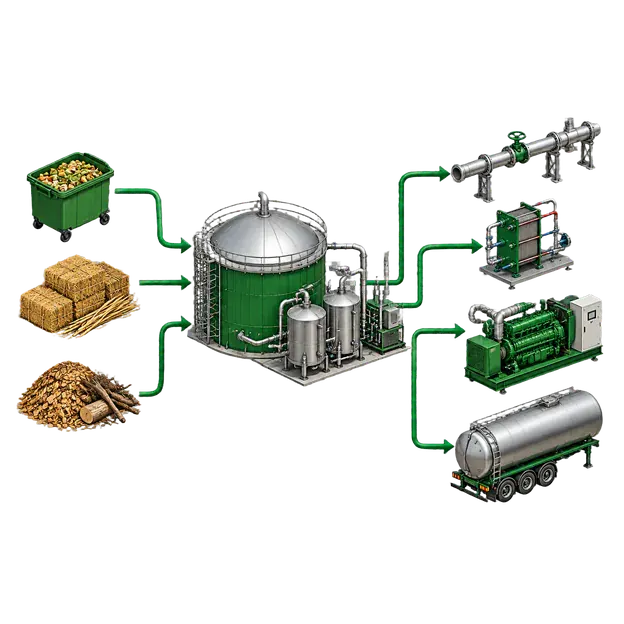
A staged path from idea to operating project
Stage 1, Opportunity identification
Question: Is there a credible resource-to-market problem worth investigating?
Record the location, existing operations or feedstock availability, intended products, possible customers, project drivers and known constraints. Screen out obvious mismatches rather than immediately commissioning a costly full study.
Indicative output: Structured opportunity brief, initial assumptions, relevant pathways and critical missing evidence.
Stage 2, Preliminary technical and commercial comparison
Question: Which practical configurations merit further analysis?
Consider production technology, plant scale, useful energy or product outputs, infrastructure, operating requirements, logistics and commercial drivers. Compare current plant use with potential upgrades; include BioCO₂, BioH₂, biomethane, CHP or regional arrangements only where technically relevant.
Indicative output: Comparative scenario model, sensitivities, constraints and a prioritised validation plan.
Stage 3, Validation and development readiness
Question: Can the assumptions withstand external review?
Validate material inputs through tests and operating records. Obtain appropriate engineering advice, supplier requirements, preliminary site and connection studies, product quality specifications, approvals pathways and early customer feedback.
Potential output: Evidence register, updated economics, technical risks, decision gates and scope for formal pre-feasibility or FEED.
Stage 4, Commercial structuring and project coordination
Question: Can the project secure feedstock, customers, permits, capability and funding on workable terms?
Develop appropriate feedstock arrangements, product and energy offtake, delivery models, technology and service responsibilities, financing and ownership structures, and the sequence required before final investment decisions.
Potential output: Development plan, responsibilities matrix and project-specific professional work packages.
Stage 5, Qualified delivery and operation
Question: Are all required contractors, contracts, approvals and financing in place to build and operate the project responsibly?
Construction, commissioning, operation and maintenance sit with the relevant contracted, appropriately qualified parties. Shelby may support commercial coordination or participate in specific project arrangements where agreed, but does not claim to be the default EPC contractor, operator or maintenance provider.
Potential outcome: A properly contracted, permitted and financed operating asset - subject to the project's own approvals, construction performance and commercial risks.
Where Shelby adds value
Australian market and resource intelligence. Connect material supply, existing plants, industrial demand, policy and infrastructure evidence.
Technology-neutral option evaluation. Compare appropriate pathways rather than favouring equipment because of a supplier relationship.
Repeatable feasibility methodology. Apply controlled inputs, documented assumptions, evidence gaps and sensitivity analysis.
Commercial project origination. Support clearer decisions about customers, logistics, project scale and development sequence.
Qualified specialist work and continued coordination. Scope engineering, independent review, legal advice, approvals, finance and supplier responsibilities with appropriately qualified parties. Where agreed, Shelby may remain involved in commercialisation and project coordination rather than simply referring the opportunity elsewhere.
Three priority development opportunities
BioCO₂ from suitable existing facilities
Investigate measured CO₂-rich streams, conditioning requirements, energy consumption, handling, transport, product quality, customer demand and incremental commercial returns. The existence of a recoverable stream does not establish a market.
BioH₂ for defined industrial uses
Assess hydrogen conversion routes, feedstock and utility demands, gas quality, site scale, delivery, lifecycle emissions, customer specifications and comparison with electrolysis or other alternatives.
Right-sized regional projects and hubs
Compare stand-alone plant upgrades, smaller modular systems, centralised facilities and shared regional assets against reliable feedstock, local offtake, transport, servicing and total lifecycle economics.
The evidence that moves a project forward
A credible development case typically needs:
- Resources: quantities, composition, sampling, seasonal reliability and supply rights.
- Technology: site-appropriate process basis, capacity, expected performance, integration and vendor qualifications.
- Customer demand: product specification, price basis, delivery location, volume and contractual readiness.
- Site and infrastructure: land, power, water, transport, networks, connections and storage.
- Economics: declared CAPEX/OPEX, availability, finance assumptions, costs and qualified revenues, with sensitivities.
- Permissions and impacts: planning, waste, environmental, safety, emissions and product-use requirements.
- Delivery capability: engineering responsibilities, commissioning, staff training, operating model and maintenance support.
A complete initial assessment will not always have these documents. Its purpose is to show which are missing and whether the project warrants obtaining them.
How commercial engagements may work
Shelby may offer a preliminary technology assessment, a defined professional feasibility scope, an agreed project-development work package, or licensing of its decision-support technology where available. Professional engineering, legal, environmental, financing and delivery services must be separately scoped and appropriately contracted.
Commercial terms, data permissions, partner responsibilities and any supplier-related compensation should be disclosed before a paid engagement. No fees, project-return claims or supplier exclusivity are implied by this page.
There is no guarantee that an assessment will recommend proceeding. A supported conclusion may be to change the configuration, obtain more evidence, defer investment or abandon the proposal.
International experience and delivery partners
Shelby's founder has worked with European renewable-gas technical and operating teams, including within the Verdemobil Biogaz environment. That experience informs understanding of design, manufacturing, distribution, operations and maintenance.
Verdemobil is an international technology relationship and potential project participant, not the mandatory supplier for every Shelby assessment. Its European installations and equipment IP remain attributable to their actual owners and developers. Australian projects require local technical, contractual, compliance and delivery arrangements.
Have an opportunity that may deserve technical and commercial review?
Start with an assessment. If the initial case is promising, clarify what evidence and partners are required for the next development gate.
Preliminary modelling, partner referrals and project-development support do not constitute engineering certification, financial advice, an investment offer or a guarantee of project delivery.
Frequently asked questions
Does Shelby finance or build every project it assesses?
No. Shelby's present emphasis is decision-support technology, opportunity assessment and commercialisation planning. Any financing, ownership, construction or operating participation requires a separate project-specific arrangement with appropriately qualified parties.
Can a project progress without hydrogen or BioCO₂?
Yes. Direct-use biogas, CHP, biomethane, industrial heat, nutrient recovery, other pathways or no development may be a better fit.
Does an opportunity check qualify me for funding?
No. Grant and financing eligibility are independently determined under the applicable terms, and project finance requires substantially more evidence.
Can you help before I have a complete feasibility study?
Yes. The preliminary assessment approach is specifically intended to identify key decisions, uncertainties and the professional work that should follow.
Sources & References
- Australian Renewable Energy Agency (ARENA), Australia’s Bioenergy Roadmap Report
Publication: Date not verified
Observation period: Not recorded
Relevant page / section: Claim-level locator not yet verified
Last link / title verification: 2026-10-11
Publisher link checked; individual claims, costs and regulatory applicability still require review.
Check scope and current applicability before relying on this reference.