Sweden biomethane roadmap: vehicle gas, bio-LNG and documented net imports
Sweden built a transport-led biomethane market that combines domestic upgrading with imported renewable gas, reaching 4,740 GWh of use in 2025 including net imports. A change to tax treatment interrupted demand, providing a valuable demand-side lesson for Australian policy and offtake planning.
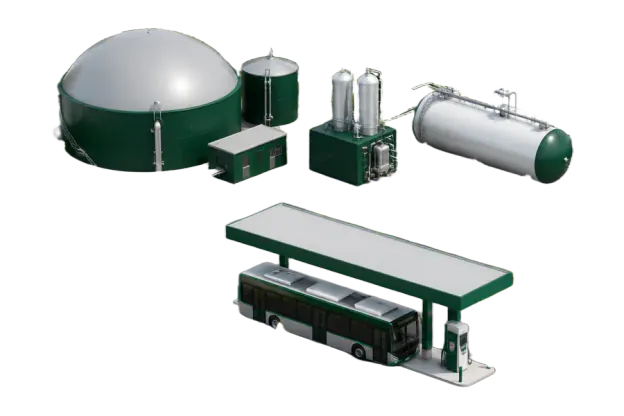
Market and technology pathways
Waste and manure co-digestion
Wastewater digestion
Upgrading to vehicle gas
Grid injection
Bio-LNG liquefaction
Biogas heat and power
Biomethane / bio-LNG
Digestate fertiliser
BioCO2 recovery opportunity; national recovered tonnage unverified
BioH2: national bio-derived production series unverified
Domestic production and trade
Reported grid imports use a connected gas system and renewable-gas accounting; they do not identify the molecules delivered to a particular user. Keep grid net imports separate from liquid biomethane net imports. Neither net figure supplies gross imports and exports.
BioCO₂ and BioH₂ evidence limits
No consistent national annual recovered BioCO2 tonnage series was verified. Recovery, purification, product qualification and the customer contract require a separate project case.
No consistent national annual bio-derived hydrogen output series was verified. Do not use total hydrogen or electrolytic green-hydrogen statistics as a proxy. Assess the biogenic feedstock, conversion route, lifecycle boundary and named buyer.
What Australia can learn
- Tax stability affects demand as well as investment; a subsidy alone does not establish a secure customer market.
- Liquid distribution may widen market access beyond pipelines, with separate logistics and liquefaction economics.
Forward development sequence — research interpretation
- Compare customer demand during stable tax treatment with the period of interrupted exemption.
- Assess pipeline supply and liquid distribution as separate delivery cases, including liquefaction, storage and transport costs.
- Combine domestic production and net imports only within the source’s stated consumption accounting boundary.
- For an Australian cluster, secure durable customer economics and logistics before extrapolating Swedish consumption growth.
Evidence limitations
- Gross biomethane physical imports and exports are not separately verified for every year.
- No consistent national annual recovered BioCO2 tonnage series verified.
- No consistent national annual bio-derived hydrogen output series verified.
Frequently asked questions
Does Sweden have verified renewable-gas import and export data?
Reported grid imports use a connected gas system and renewable-gas accounting; they do not identify the molecules delivered to a particular user. Keep grid net imports separate from liquid biomethane net imports. Neither net figure supplies gross imports and exports.
Is there a national BioCO₂ or BioH₂ production figure for Sweden?
No consistent national annual recovered BioCO2 tonnage series was verified. Recovery, purification, product qualification and the customer contract require a separate project case. No consistent national annual bio-derived hydrogen output series was verified. Do not use total hydrogen or electrolytic green-hydrogen statistics as a proxy. Assess the biogenic feedstock, conversion route, lifecycle boundary and named buyer.
What are the limits of the Sweden roadmap evidence?
Gross biomethane physical imports and exports are not separately verified for every year. No consistent national annual recovered BioCO2 tonnage series verified. No consistent national annual bio-derived hydrogen output series verified.
Sources & References
- energigas.se, Energigas Sverige, Energigas Sverige, Biomethane in Sweden: market overview and policies
Publication: Date not verified
Observation period: Not recorded
Relevant page / section: Claim-level locator not yet verified
Last link / title verification: Not verified
Verification incomplete, do not rely on this reference for an investment or approval decision.
Source metadata and claim-level evidence require verification.
- energigas.se, Energigas Sverige, Energigas Sverige, Statistics on biogas, 2025 results
Publication: Date not verified
Observation period: Not recorded
Relevant page / section: Claim-level locator not yet verified
Last link / title verification: Not verified
Verification incomplete, do not rely on this reference for an investment or approval decision.
Source metadata and claim-level evidence require verification.
- pxexternal.energimyndigheten.se, Swedish Energy Agency, Swedish Energy Agency, Biogas production by installation category, 2005–2025
Publication: Date not verified
Observation period: Not recorded
Relevant page / section: Claim-level locator not yet verified
Last link / title verification: Not verified
Verification incomplete, do not rely on this reference for an investment or approval decision.
Source metadata and claim-level evidence require verification.